Showing posts with label crafty technique. Show all posts

Sunday, 7 May 2017

Create a work of art using up your crafty stash....

I would definitely consider myself a messy crafter, not just by the state of my desk but also because I love getting out paints, inks and using lots of different mediums together and they usually end up all over my hands!  I have always used whatever I have, mixing medias, to create the look and effect I want.  In the last year I've noticed mixed media is becoming more popular and if you've not tried it this is why I think you should....
  • There are no rules.
  • You don't need to be able to draw or consider yourself an artist.
  • Many materials = endless techniques
  • Encourages risk taking and not worrying about the end result
  • Multiple materials can inspire new ideas
  • Anything goes, so collect everything!
  • It's FUN!!!
To get you started I am going to show you a great way to use up your crafty stash and create a piece of mixed media art....

how to create a piece of art using up your craft stash

What you need
  • Box canvas. You can get these quite cheaply. I got a pack from Wilkos
  • Gesso, white or black
  • Acrylic paint, choose co-ordinating colours of your choice.  I recommend 3 or 4 but remember there are no rules! You can also use tester pots or left over emulsion to co-ordinate with your home decor
  • Paint brushes and sponges
  • Embellishments from your crafty stash, anything goes. It doesn't matter what colour they are. This is a great time to use the bits and bobs you don't really like or you'll never use.
  • Strong PVA or a hot glue gun
Optional
  • Texture paste
  • Stencil of your choice
  • Palette knife
  • Gilding wax
To get started I placed a stencil on the canvas and spread the texture paste over it with a palette knife. I wasn't concerned about it being smooth, the aim is to add texture.  If you don't have texture paste or stencils you can miss this step.

Applying texture paste using stencils onto canvas

Next arrange your buttons, ribbons, wooden embellishments, any random bits and bobs you have collected on to the canvas. It doesn't matter what colours they are or if they clash because they won't stay like that. Once you are happy with the arrangement glue them down securely with a strong PVA or glue gun.  You can also use your glue gun to create patterns and add texture.

canvas with floral embellishments and tecture paste

If you are using the texture paste you can stencil over some embellishments as well like I have done with this ribbon.


Once the glue has dried go over everything with white gesso.  This will prime the various surfaces of the embellishments, paste and canvas so they can take the paint.  Without gesso, the paint would soak into porous surfaces and/or dull the colours of your paint if the original surface is dark. Gesso is not opaque so you will still see some of the colour peeping through.

white on white canvas art

You may like this effect, if so you can stop here. Or if you want a more 'white on white' effect then paint again with white acrylic paint.

Both gesso and acrylic paint may not cling very well to shiny or plastic items, but that's OK, I have a solution for that further on. Just paint over what you can.

Now, with your acrylic paints in various colours here are some options as to what you could do next....

With a dry brush add colour to highlight details.  If you don't like the streaks of the dry brush just add a little water to your brush.


Go lightly with the paint, you can always add more but it's harder to take it away.  However if you have over worked any areas use the gesso to calm it down and blend.

I only used 2 colours in this piece which were inspired by the embellishments used.

To highlight areas, and to cover the buttons that wouldn't completely cover with the paint, I used silver gilding wax.  I love this stuff!  It can really make a piece pop and it covers the areas that the paint couldn't.

For this next one I created I used a lot more colour....


After painting with white gesso, I applied a base coat in the palest colour roughly with a brush.


I used sponges in the next step to get a different finish. I added orange and green paints and went back over areas with the pale colour to add depth and help blend the colours.  I just kept adding colour until I was happy with how it looked.


I used the gesso again to highlight areas and added wooden words found in my stash to finish it.


You can also use gesso in black which is what I used for this one....


Canvas using black gesso

I followed the same process of stencilling then painting with black gesso and I used metallic acrylic paint and applied it with a dry brush allowing some of the black to still show through.


Pebeo metallic paints over black gesso

I highlighted areas with gilding wax

Pebeo gilding wax over metallic paints and black gesso

I then added Aged Copper Frantage to add even more texture and give it an aged look. This works like embossing powder (you can check out my tutorial on embossing powder here). I roughly added a Versamark ink pad over areas I wanted the frantage to be and sprinkled the powder over these areas.  I wasn't worried about it being neat or if the powder went in other areas. Using a heat tool I heat embossed the frantage powder and then repeated this 2 or 3 times in areas so it was thicker in different areas.

Mixed media art using Frantage, gilding wax and acrylic paints


This is definitely my favourite!  Different colours are more prominent depending on the light and angle due to shine and texture of the paints, gilding wax and frantage.

Here you have three very different looking pieces of art using up my stash.  What do you think?


If you create a piece of art inspired by this tutorial I'd love to see it so please tag me on social media.


This tutorial is for non-commercial use only. You can make for yourself, gifts or to raise funds for a charity but please don't make any to sell for profit.

If you want to blog about this project, remember to credit me and link back to this blog. Please ask permission before using my photography and please do not reproduce my entire tutorial.  Thank you


Thursday, 4 August 2016

Upcycle project ~ squeaky dog toy....

My new puppy, Jenson, has inspired my latest crafty make for the latest #CraftBlogClub upcycling challenge.


The challenge was launched by Jenniffer Taylor of the #SewingRevolution and Sewing Bee fame and all we had to do was upcycle anything.  So using an old pair of jeans and fleece jumper I decided to make a squeaky dog toy.

What did I use....


  • Old pair of jeans. Denim should be hard wearing enough for my teething pup
  • Old fleece jumper for the chew ties
  • Matching thread
  • Polyester toy filler
  • Dog toy squeaker. I used Kong replacement squeakers which I bought from my local independent pet store but they are also available online.
  • This tutorial by Laura Griffin which includes a template.

It was a great opportunity to dust off my sewing machine.


Laura's instructions were easy to follow and it only took me a couple of hours to make.

The Finished Dog Toy!

I think it was a big hit with Jenson! As soon a I gave it to him he ran around with it and then hid under the dining room table to play, making sure no one could take it away from him! 


I enjoyed getting my sewing machine out again, I don't use it enough. I am now on the look out for my next sewing project.

Have you taken part in the challenge? Even if you haven't taken part in the challenge but have done an upcycling project I'd love to see it, please share your links below so I can check them out.


Disclaimer: The Amazon links in this post are affiliated

Sunday, 27 March 2016

Guest Blogger ~ Standing Stitch Tutorial by Katherine Hajer....

We're nearly at the end of National Craft Month, have you tried any new crafts? 
I hope you have enjoyed all the guests I've had on my blog this month.  For the final instalment, Katherine is back sharing her tutorial on crochet standing stitch.

You can see her foundation stitch tutorial which she shared at the beginning of the month here.

Over to Katherine....
Here’s a situation: you are crocheting something in stripes, and you've got to the point where it’s time to change colours and start the next stripe. If you do things the traditional way, you:
  1. Drop the old yarn at the penultimate step in completing the last stitch on the old row.
  2. Pick up the new yarn and complete the stitch.
  3. Chain however many you need to start the next row.
  4. Turn the work.
Or maybe: you are working on a multi-coloured motif, and have finished off the old colour. Now you’re supposed to attach the new yarn, chain up, and keep working. Except, if you’re like me, that starting chain is always very obvious, and it bothers you.
Here’s an alternative: you could skip both those scenarios and just use a standing stitch.
A standing stitch is a method used to join new yarn to an existing piece of crochet without having to do any of the steps listed above. It also has these additional benefits:
  • The old yarn is fastened off completely before the new yarn is added, so you don’t have to worry about keeping two different yarns under control as you add a new colour.
  • You don’t have to work back and forth. If you want to work right to left for a one-row stripe, then start at the right-hand side again and work right to left again for the next one-row stripe, it’s just as easy as turning the work and going the opposite way.
  • If you’re working in the round, you can stagger your start and stop points each stripe so that you don’t wind up with all your loose ends in one spot. This is very handy on granny squares!
(Note: since this post is being published on a British Web site, British crochet terms are used throughout. Here's a handy list for converting terms.)
If you prefer a video demonstration to written instructions, you can watch this.
What you need before you start: something to crochet onto. Usually this will be a piece of crochet that’s already done. If you are finishing a round/row and then starting a new colour, finish off the old yarn as if you were completing the piece (ie: clip yarn, pull short end through last stitch).
Proceed:
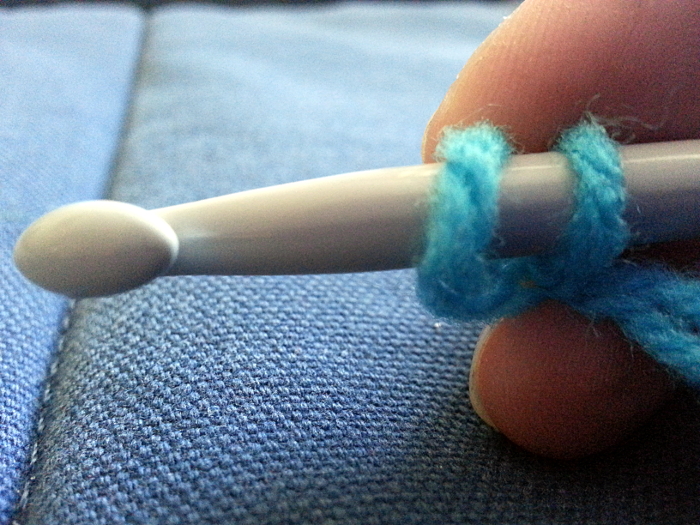
  1. There are different ways of doing this, but you want to have as many loops on your hook as you would have before you inserted your hook for a new stitch mid-row. In the photo below, I'm going to join the new yarn with a treble, so I have two loops on my hook. Crocheters more experienced with the technique often just use a backward loop and a regular yarn over, but if you’re trying this for the first time, I recommend making a slip knot for the first loop so everything stays secure.
    01 standing st starting lp.jpg
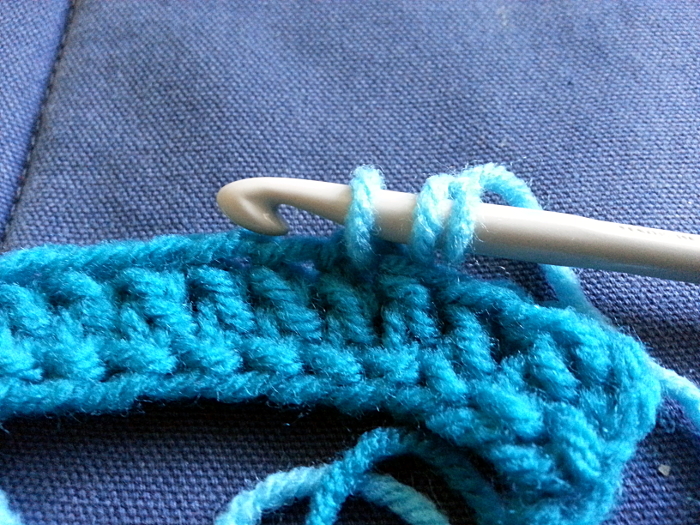
  2. Insert your hook into the work and work a stitch as normal. Once the stitch is complete, the new yarn will be attached to the work and you can work the rest of the round/row as normal.
    02 standing st attach to work.jpg
  3. That’s it! If you did use a slip knot but do not like knots overall, you can pick it open with a tapestry needle when you are finishing your loose ends. Or you can just leave it.
Note that working a standing stitch means the beginning tail of your new yarn will be located at the top of the first stitch in the new yarn, rather than the bottom as it would be using the traditional method. This doesn't make darning in the ends any easier or harder than using the traditional method. It just means you may have to use a slightly different strategy than normal when you’re finishing.
-------

Thank you Katherine for sharing not one but two crochet tutorials on my blog this month! 
Find out more about Katherine over here....
check out her website
find Katherine on Twitter


A big thank you to all my guests who have shared their craft tutorials to help me celebrate National Craft Month. You can see all their tutorials here, including the ones from last year.

I always like to see what you make from the tutorials on my blog. If you make anything I'd love to see them so please tag me in your social media posts or leave your links in the comments below so I can check out your makes.


fizzi~jayne x

Monday, 21 March 2016

Guest Blogger ~ Upcycling Project by theMessyBrunette....


It's time for another guest to celebrate National Craft Month! Maura from theMessyBrunette is sharing a tutorial for an upcycling project. I do love upcycling, mainly because I can't bear to throw anything away and it gives something a new lease of life.

Over to Maura....


Hi, my name is Maura and I blog over at theMessyBrunette.  I love crafts and upcycling projects and I also crochet.  I eat far too much chocolate and spend too long on Pinterest.

A big thanks to Fiona for letting me guest post on her lovely blog.  I hope you enjoy my post and please feel free to pop by my blog for a visit.

I've posted before on decoupage and using it on upcycling projects, you can read about it here.  With this project, I had some plate chargers, you know the ones that make an appearance at Christmas. Well, we had a bunch of these that we never used and I was going to dump them, when I thought hmmmm maybe they could be used.  So I decided to try and cover them with some paper and make them seem like they're old and vintage looking.

So here's the plate before - just your regular silver plastic plate charger, nothing fancy with this one.  You can get this in the Pound/Euro shop, they are not expensive.

And here's the after.  I did 4 plates with 4 different looks using napkins on some and scrapbook paper on others.  I wanted the plates to look old and worn, kinda vintage looking. What do you think?


Want to know how I did it? Well here's a little summary.

NAPKIN PLATES:

The aim was to make the plates look old & worn, vintage looking ......
  • I cleaned and lightly sanded the plate
  • I painted the plate in white. I did two coats to give it a good coverage.
  • I separated the napkins and only used the first layer - see below, it's important you only use the first printed layer.  I tore the pieces that I wanted to use and played around with the design. (On the green plate I didn't tear it up I just carefully placed it on the plate and glued it bit by bit & blended it in.)


  • I then used some decoupage glue (you could use some watered down PVA or Mod Podge but I find this glue the best with napkins) and glued the napkin pieces.  They wrinkled in places but I didn't mind as I think the wrinkles make them look old.


  • At the edges, I used some bitumen (a liquid paint for decoupage) and rubbed it along with my finger.  You could use some dark wax but be careful, a little goes a long way.  I used some on the inner rim as well.
  • Next up I used some rice paper (rice paper is a little bit thicker than napkins and easier to use I find). I had some with "home sweet home" printed on it. I tore around the print and glued this on top of the napkin and lightly sanded it to blend it in.  I used some bitumen on this as well to age it.

  • On the blue plate, I used some gold leaf around the edges

  • I sealed the plates with some clear varnish and lightly sanded them when they were dry.  I repeated this process until I was happy with the result.  Be careful here as you don't want the paper to tear. Just lightly sand it!

SCRAPBOOK PLATES:
  1. I cleaned and lightly sanded the plate
  2. I soaked the paper in water and peeled off the back, I did this as the paper was a bit too thick to use and it was easier to use if the paper was a bit thinner.
  3. Using some decoupage glue I glued the paper down to the plate and rubbed it into the plate's rim and all around.  Now it did wrinkle a bit here and there, but as I wanted it to look a bit old and worn I didn't mind this. Wrinkles can be good!
  4. Now the paper didn't cover the plate fully, there were gaps on each side.  So I used some regular acrylic paint and blended the paint to the colour of the paper.  I sanded and distressed this until I got the look I wanted.
  5. Next up, I used some gold leaf.  I just placed the glue on the parts I wanted the gold leaf to appear, this was in and around the edges of the plate. I wanted the plate to look old and that the paper was peeling and coming away.  I used some bitumen to make the paper look old in places as well.  You could use dark wax or even an old tea bag to stain the paper.
  6. I left it to dry and coated it again with the glue to seal it. I lightly sanded it afterwards, the paper part only.  I did this a couple of times to make sure everything blended in together.


Note: these plates are only for decorative purposes, just a wipe of a cloth will keep them clean.

So that's it, hope you enjoyed the process, if I have left anything out or you need to know more please comment below.

So have you done any upcycling lately?

------

Thank you Maura for sharing your upcycling project. You can find lots more of Maura's crafty DIY projects as well as baking goodness on her lovely blog. Maura is also on Twitter and Instagram.
Just a tip from me, If you can't find bitumen paint, I use Distress Inks for making projects look old and vintage.

If you have upcyled anything, Maura and I would love to see it so please leave your links in the comments or tag us in your social media posts.

fizzi~jayne x


Friday, 18 March 2016

Guest blogger ~ knit a sock by Rachel Rayner...

It's time for my second guest and I am very pleased to have Rachel sharing a knitting tutorial.  I've not featured knitting on this blog before as I don't knit but I do love yarn! So I'm happy Rachel agreed to share her knitting knowledge with us.

Rachel has recently moved to the UK from New Zealand and is a multi talented lady, not only does she knit but Rachel can also play the ukulele.

Over to Rachel....

So you want to become a sock knitter. Welcome! Your life is about to become a whole lot more interesting. 

This tutorial will run you through the steps, and show you how to knit a basic toe up sock. Socks vary tremendously in the details, but they share enough characteristics that once you've knitted this sock and a cuff down sock (a tutorial on this will be available soon on Rachel's blog), you will have the skills to knit just about any sock pattern there is.

Why knit socks?

Socks are wonderful. They’re everyday, almost-all-year-round items (this depends on your climate, but you’re more likely to wear a sock than a scarf in summer!). They’re small enough to throw in your handbag, and have a small enough profile that you can knit on the bus without knocking elbows with your neighbour. 

Plus: sock yarn is beautiful. Brights, pastels, solids, stripes or patterns, there’s a sock yarn to suit you, in merino, nylon, cashmere, silk or handspun. 

Convinced? Then let’s get started.

What you need to knit socks
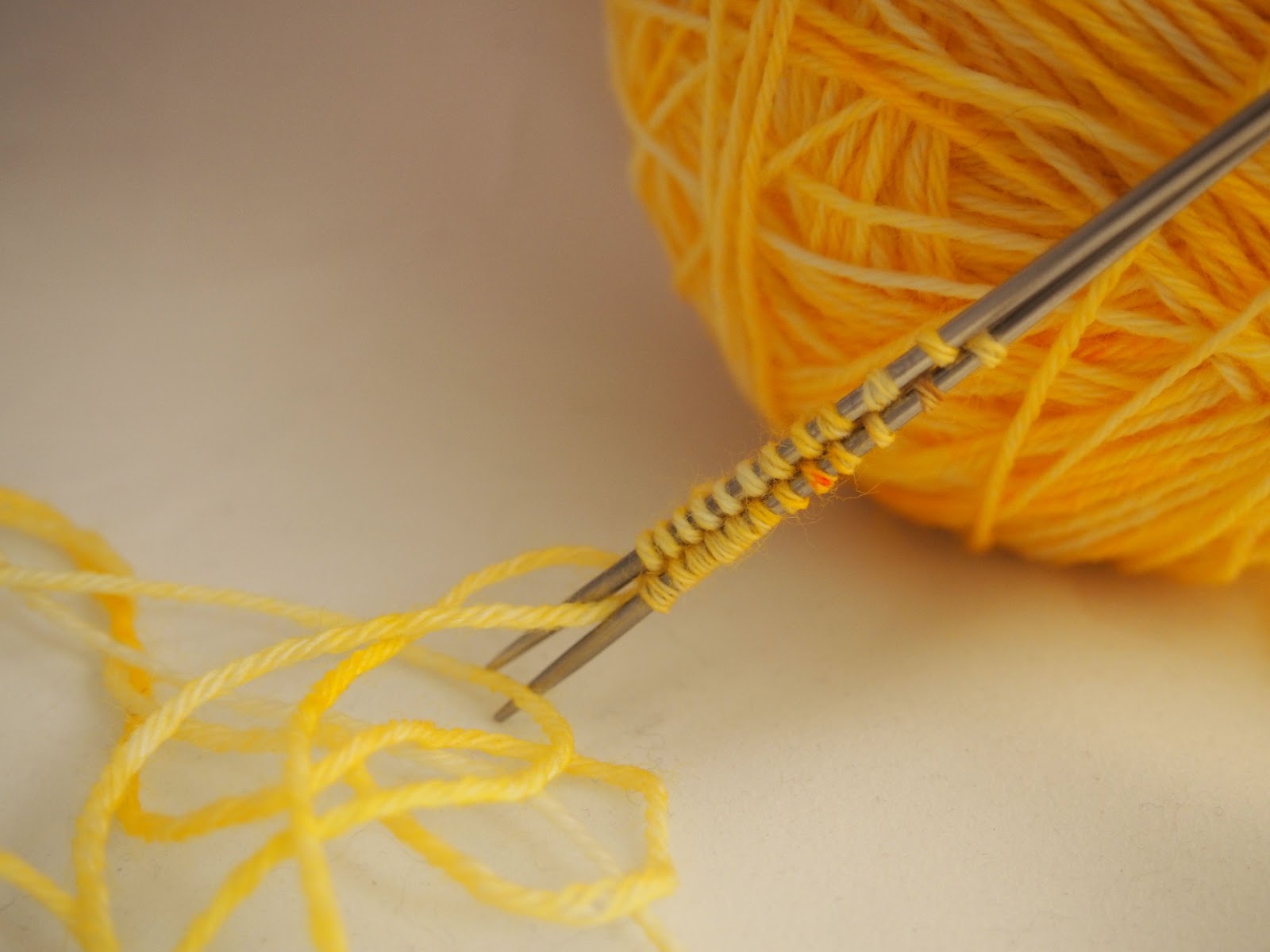
First, you need a ridiculously small pair of circular needles. 1.25mm if you’re a loose knitter, or 1.75mm if you tend to knit tightly. You can also use DPNs, if you prefer (but I don’t). I magic loop, so I'm presuming you’re doing the same.


Next, you need sock yarn to put on your needles. Look for a tightly plied yarn, which is likely to wear better – if it contains nylon that’s better still. But if we wanted socks to last forever, we’d knit with steel wool. What we want is a lovely experience from start to finish, so pick a yarn which you enjoy touching, in colours which sing to you.

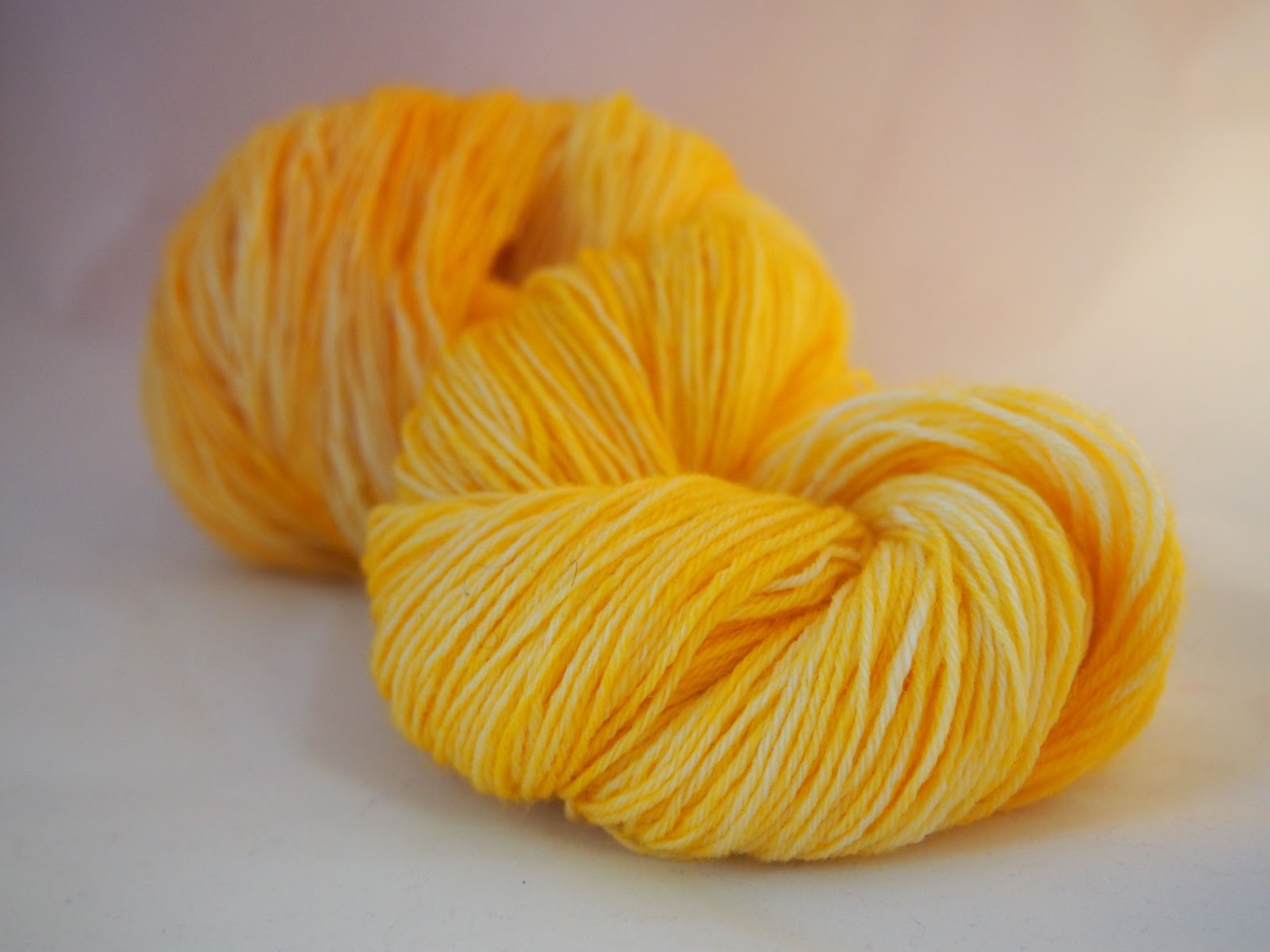
In the examples I'm using a 100% merino base, which I dyed myself with Kool-Aid (that could be a tutorial in itself… (keep an eye out on Rachel's blog for that!

Finally, you need a locking stitch marker or two and a yarn needle for weaving in ends.

A word about gauge

Socks need to be knit at a nice tight gauge so they wear well. Think about other things you've knitted, a lace shawl wrapped around your foot (heavens forbid) would be shredded to pieces in an afternoon. A hat would hold up much better. What’s the difference? Lace, of course, has holes in it, while hats tend to be knit more closely. We want to knit tightly, while still allowing the sock (and the foot!) to move. 

Aim for a gauge of about 10 stitches per inch, or, more importantly: a fabric which is comfy for you to create (no hand cramps!), looks nice, and isn't too stiff. Because socks are so small and knit in the round, there’s not much point in making a gauge swatch – it will take you longer to do that than it would to cast on and rip out! 

I have given a stitch count but not an exact gauge in these patterns, because the fabric is what’s important. You can try on your sock as you go, and even if it doesn't fit you, it will fit someone. Socks make marvellous Christmas gifts. 

Sock Knitting Techniques

As well as ribbing, and increasing and decreasing, socks use a few more advanced techniques:


Technique
Toe Up
Casting on
Turning the heel
Casting off


This tutorial contains links to videos which will walk you through any unknown techniques. This pattern calls for ribbing, so you must be able to knit and purl! It also calls for increases and decreases - I have used knit-front-back and knit 2 together throughout, but you can use whatever increases and decreases you choose. 

Simple Toe Up Sock Pattern

These socks are a little different from your “usual” toe up sock, as they contain a heel flap! While these instructions seem long, I've broken them down into their component parts - each section really is quite easy.

Toe
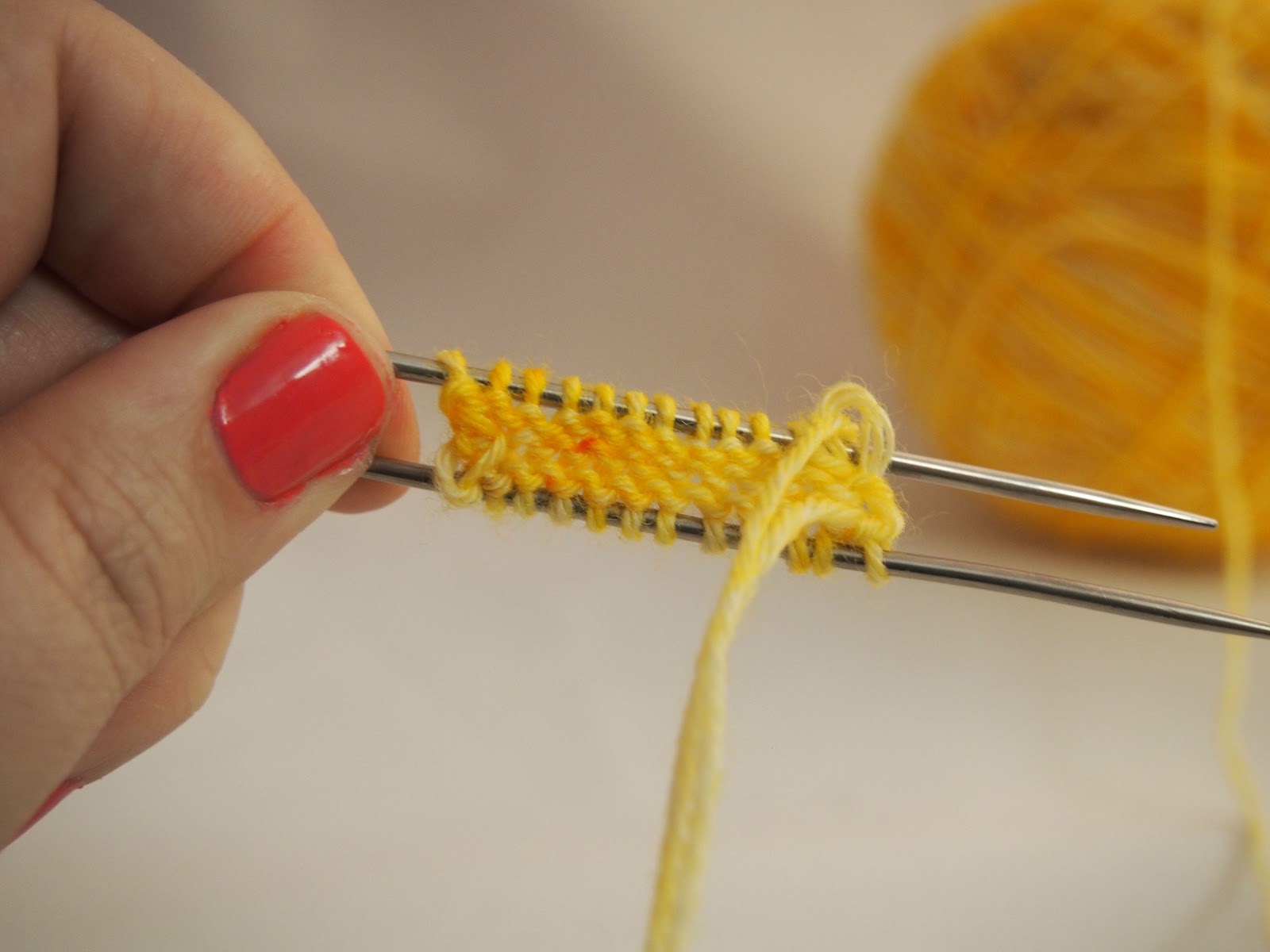
Using Judy’s Magic Cast On, cast on 24 stitches - 12 on each needle.
This cast on takes a little practise, but if you've worked the long tail cast on, you should get it quickly. It’s the sort of thing that’s best explained visually, so watch this video.


Once you've cast on, we can begin the toe!


  • Round 1: Knit. Place a marker after 12 and 24 stitches, so your sock is in two halves.
  • Round 2: Knit 1, increase, knit until one stitch before end, increase, knit 1.
  • Repeat rows 1 and 2 until you have 56 stitches. Try it on! It should fit over your first four toes, with your pinky sticking out the cold. If your sock is too small, increase a few more stitches. If it’s too big - I'm sorry, you’ll have to rip back and stop increasing at an earlier point. If you make any changes, make a note of your stitch count.

Foot

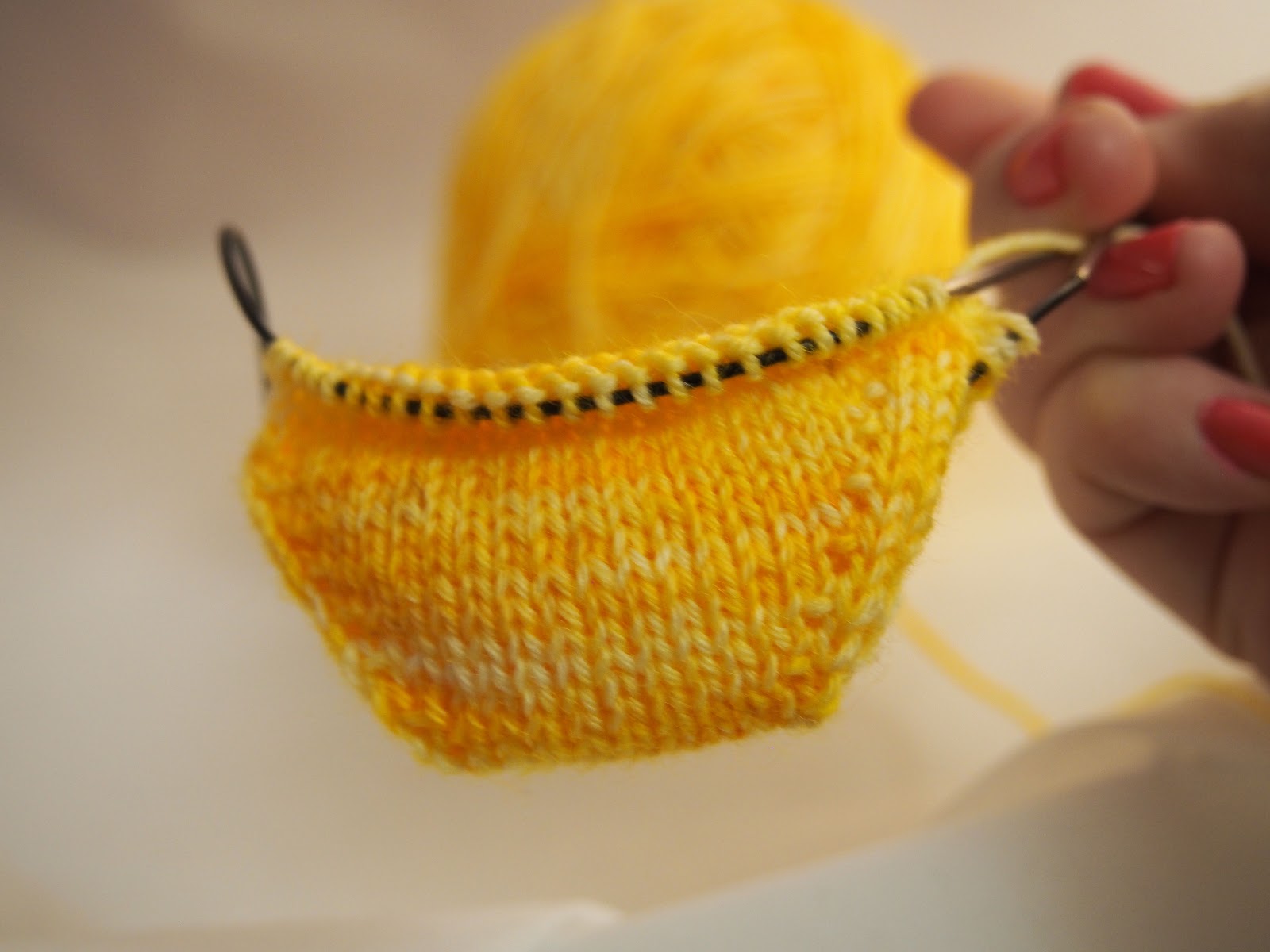
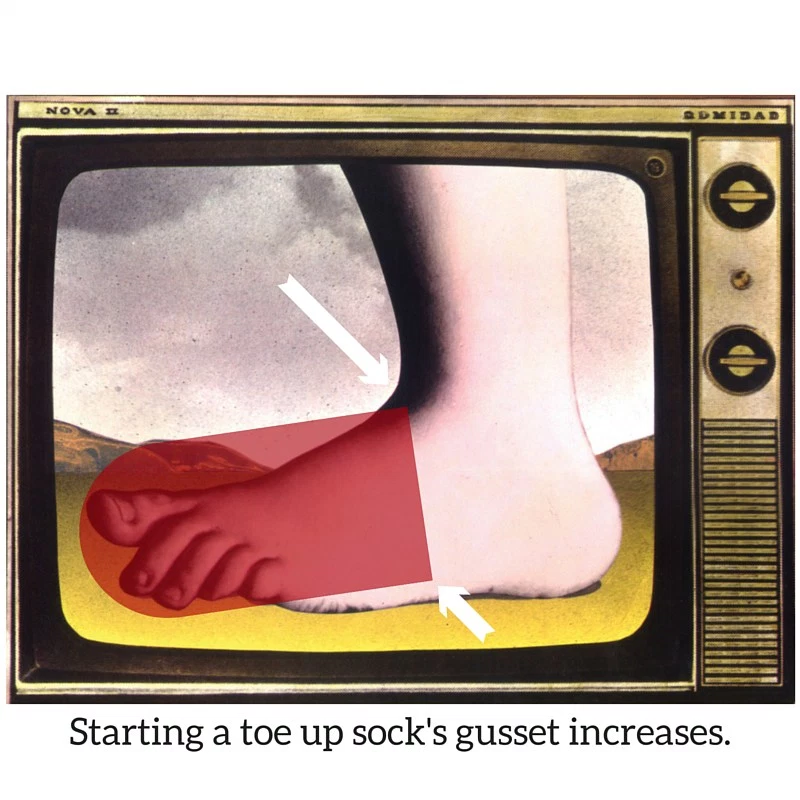
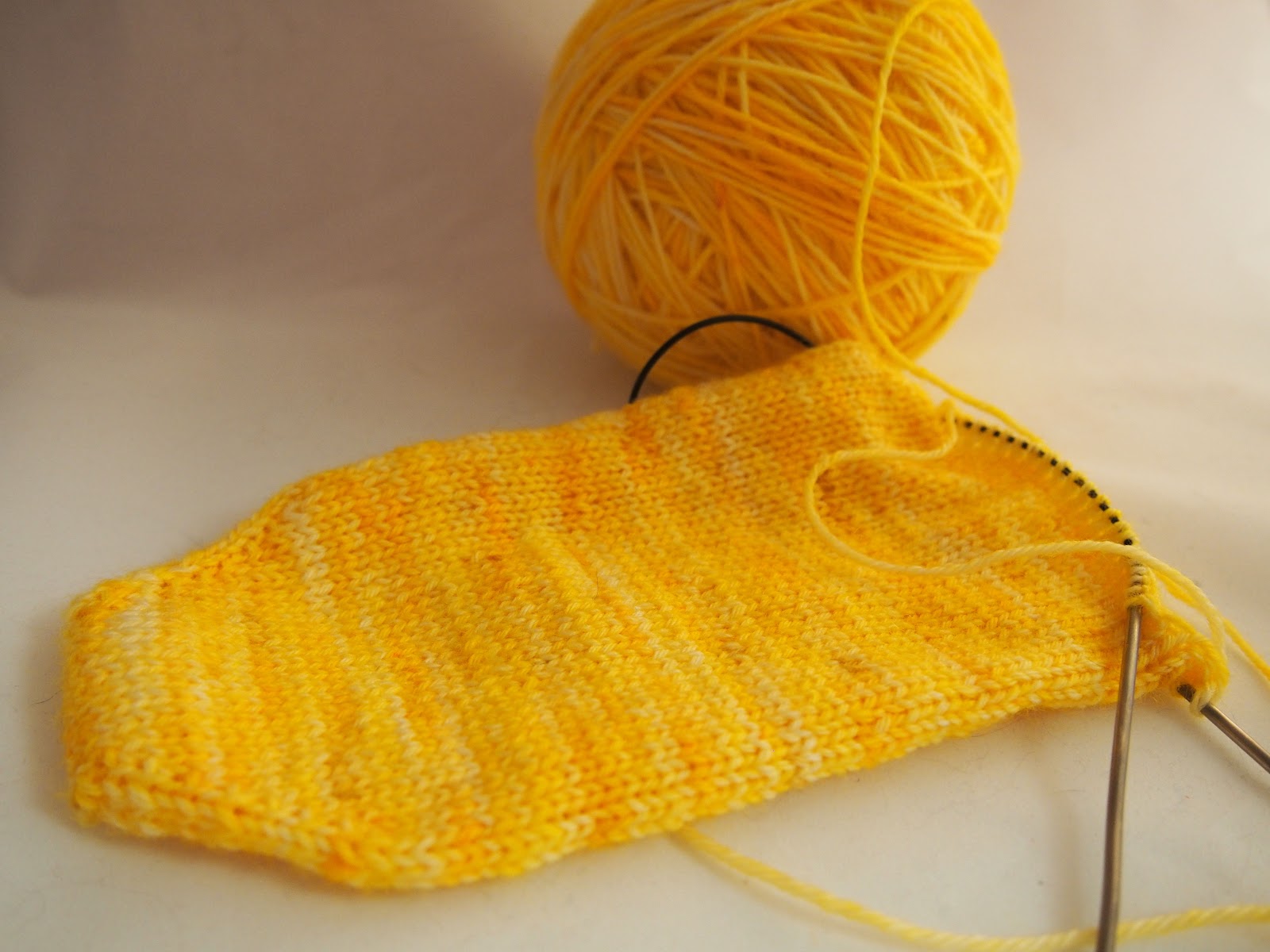
Knit until the foot reaches the front of your ankle joint, where your leg hits your foot. This instruction always confused me when I was a baby knitter (the foot joins the leg all the way round! I wailed, until a knitting friend corrected me). To save you my confusion, I've made you a diagram, originally shared over at my blog.


Gusset Increases

(“What’s a gusset?” A gusset is a wodge of extra fabric. In knitted socks, it adds room to hug your instep, and give the heel extra space.)


  • Round 1: Knit
  • Round 2: Decide which side is going to be the top of your sock. It will always be knit plain. Knit the top of the sock, then slip marker, knit 1, increase, knit until one stitch before end, increase, knit 1.
  • Repeat rounds 1 and 2 ten times - you will have increased by 20 stitches.

Turning the Heel

This is meant to be the “scary” part of knitting socks! Don’t freak out - just trust the pattern and everything will come together. 

I had 48 stitches on heel needle - my original 28 stitches, plus 20 from the gusset increases. You may have a few more or less, and that’s okay. You’ll see that on Row 1 I knit 70% of the way across the heel. After that, the stitches were wrapped and turned in a very predictable pattern. You can absolutely fudge the stitch count here. Just try and do same number of short rows as I have here.


What are short rows?

Short rows are where you just knit across some of the stitches on your needle, then turn and head back the other way - a short row! This video explains the details. 

To turn the heel

This is worked entirely across the heel needle. We will ignore the front needle for now.

  • Row 1: Knit 33 or 70% of the way across the heel needle, increase 1, wrap and turn (wt)
  • Row 2: Purl 16,  increase 1, wt
  • Row 3: Knit 14, increase 1, wt
  • Row 4: Purl 12, increase 1, wt
  • Row 5: Knit 10,  increase 1, wt
  • Row 6: Purl 8, increase 1, wt
  • Row 7: Knit 6, increase 1, wt
  • Row 8: Purl 4,  increase 1, wt
  • Knit around the heel needle, and over the instep, picking up and knitting wrapped stitches as you go. 54 stitches (or your original count + 8) on heel needle


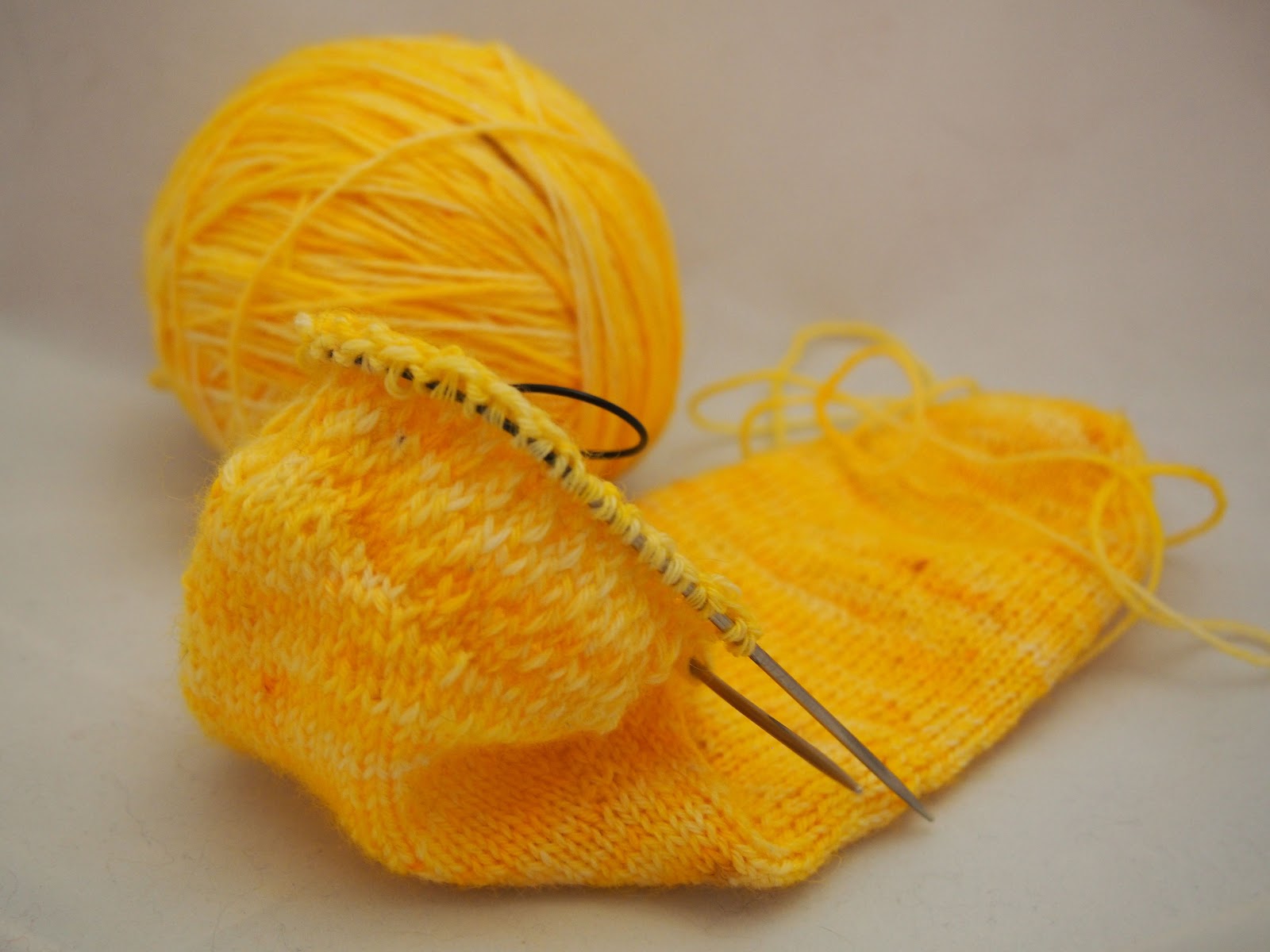
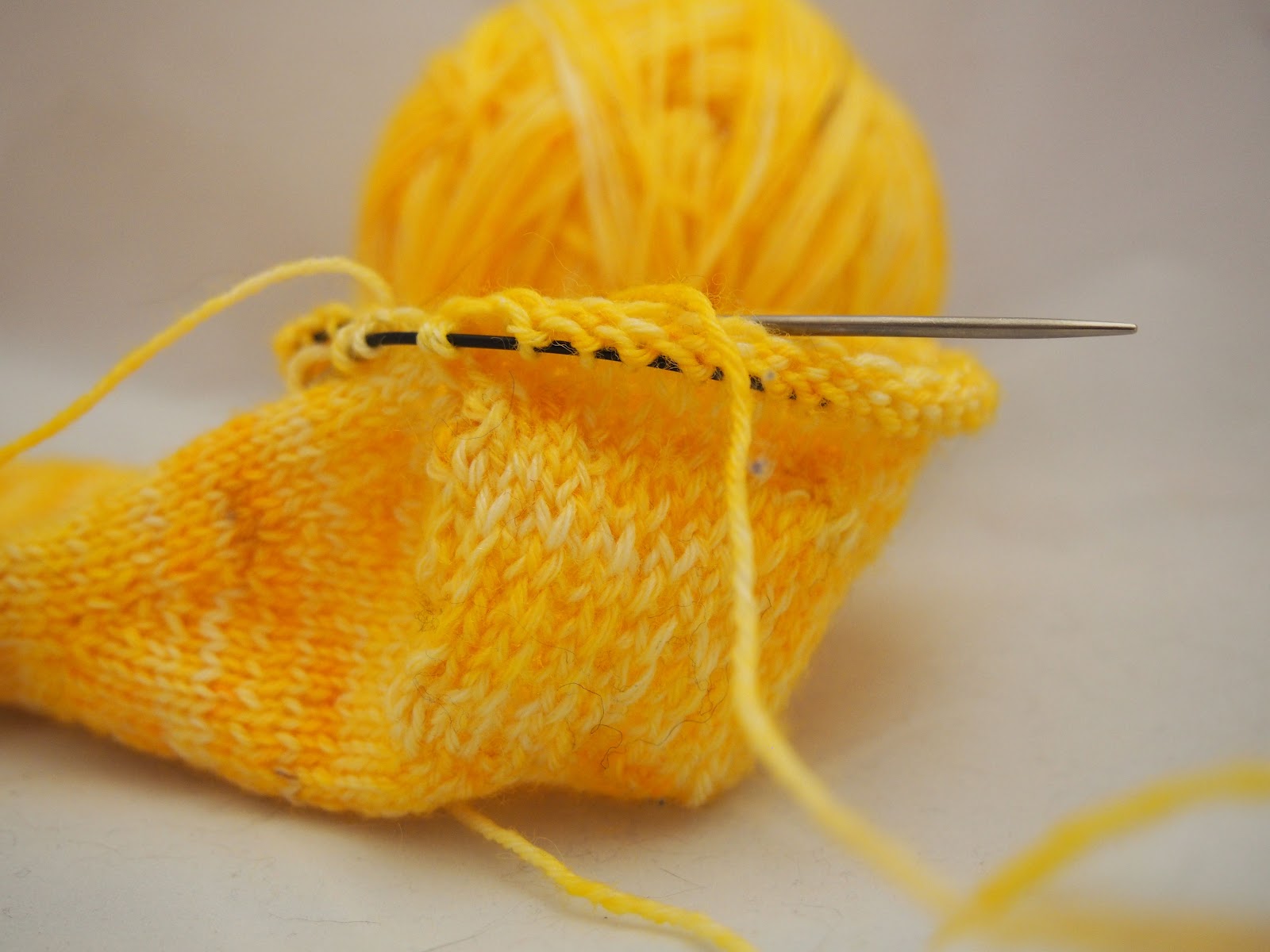
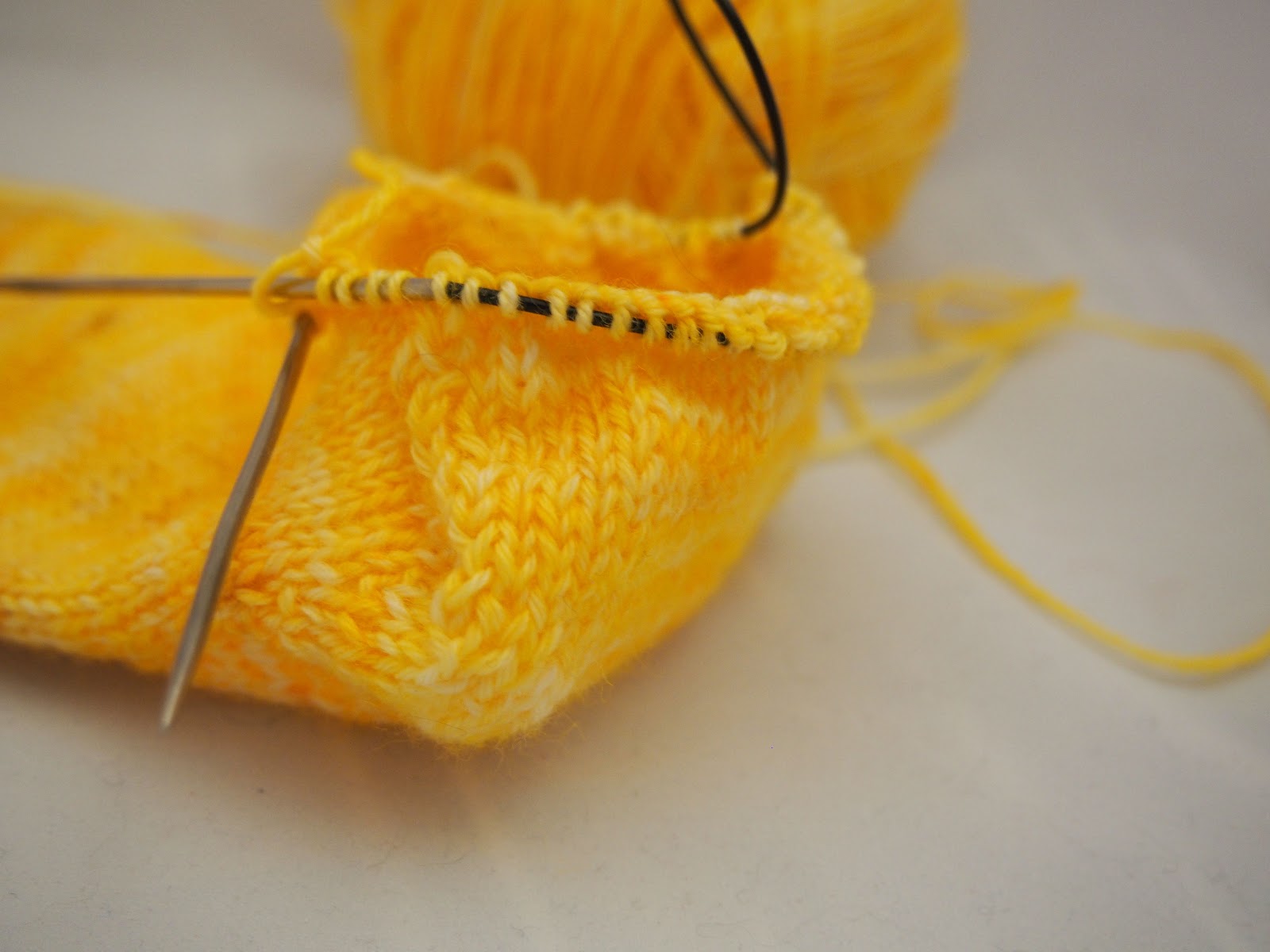
The heel is turned! If you pick up and poke at your knitting, you’ll see you've created a little pocket. This is where the base of your heel will snug into. Next, we’re going to knit the heel flap, while simultaneously decreasing away the extra twenty stitches.


We’re going to knit the heel flap in Blinking Eye of Partridge. The traditional heel flap stitch, Eye of Partridge, is a simple two row repeat which goes like this:

  • Row 1: Slip 1, Knit 1
  • Row 2: Purl


In traditional Eye of Partridge, all the slips and knits line up in neat rows. In Blinking Eye of Partridge, they fall unevenly, producing a more textured stitch which is just as beautiful in its own way (and a lot easier to work in conjunction with decreases!). 

To knit the heel flap (again working on the heel needle only):

  • Row 1: Knit in Blinking Eye of Partridge (slip 1, knit 1) until 10 stitches from end. Decrease. Wrap and turn (wt)
  • Row 2: Purl until until 10 stitches from end. Decrease. Wt
  • Row 3: Knit in Blinking Eye of Partridge until you reach the decrease. Knit the decrease and the following stitch together. Wt
  • Row 4: Purl until you reach the decrease. Knit the decrease and the following stitch together. Wt
Repeat rows 3 and 4 until you have decreased away all your stitches. Knit around all stitches on both needles.


If you find you have a “gap” where the heel flap meets the front of the foot, simply pick up a stitch from the row below, then immediately knit it together with the next stitch. Or, darn it shut later. 

Knit plain around for at least a good inch, or for as long as you would like the sock to be (try it on if it gets too long: you will likely have to add increases should you knit past the calf muscle). 

Add at least an inch of 2x2 ribbing (knit 2, purl 2). 

Cast off using Jeny’s Surprisingly Stretchy Bind OffIf you don’t already know this method of casting off, be sure to watch the video - it’s a revelation! 

Weave in the ends, and you’re done! You've made a sock!
-----------

Thank you Rachel for sharing this tutorial. I love the yarn you used, so pretty!
You can find Rachel on....
Twitter
Her blog

If you have any questions about this tutorial leave your query in the comments and if I can't help I will ask Rachel for you.

I always like to see what you make from the tutorials on my blog. If you make these socks I'd love to see them so please tag me and Rachel in your social media posts or leave your links in the comments below.

fizzi~jayne x